"Growth is constrained, not by ambition, but by the bottleneck nobody sees yet."
In each case below, the constraint on growth wasn't capital, market demand, or effort. It was something narrower — a pricing structure, a leak in a process, a rented middleman — sitting in plain sight until someone actually looked. Find it, remove it, and the number moves: 6x, 10x, sometimes further.
None of this is an argument for swapping people out for software. Read Case #2 and you'll see the one time I did remove staff — and it happened because they'd already shown me, over years, who they were, not because a system beats a person by default. People are the reason any of this mattered in the first place. The fixes below just cleared what was in their way.
Positioning & Distribution — The $20M LaMusica / SBS / AOL Partnership
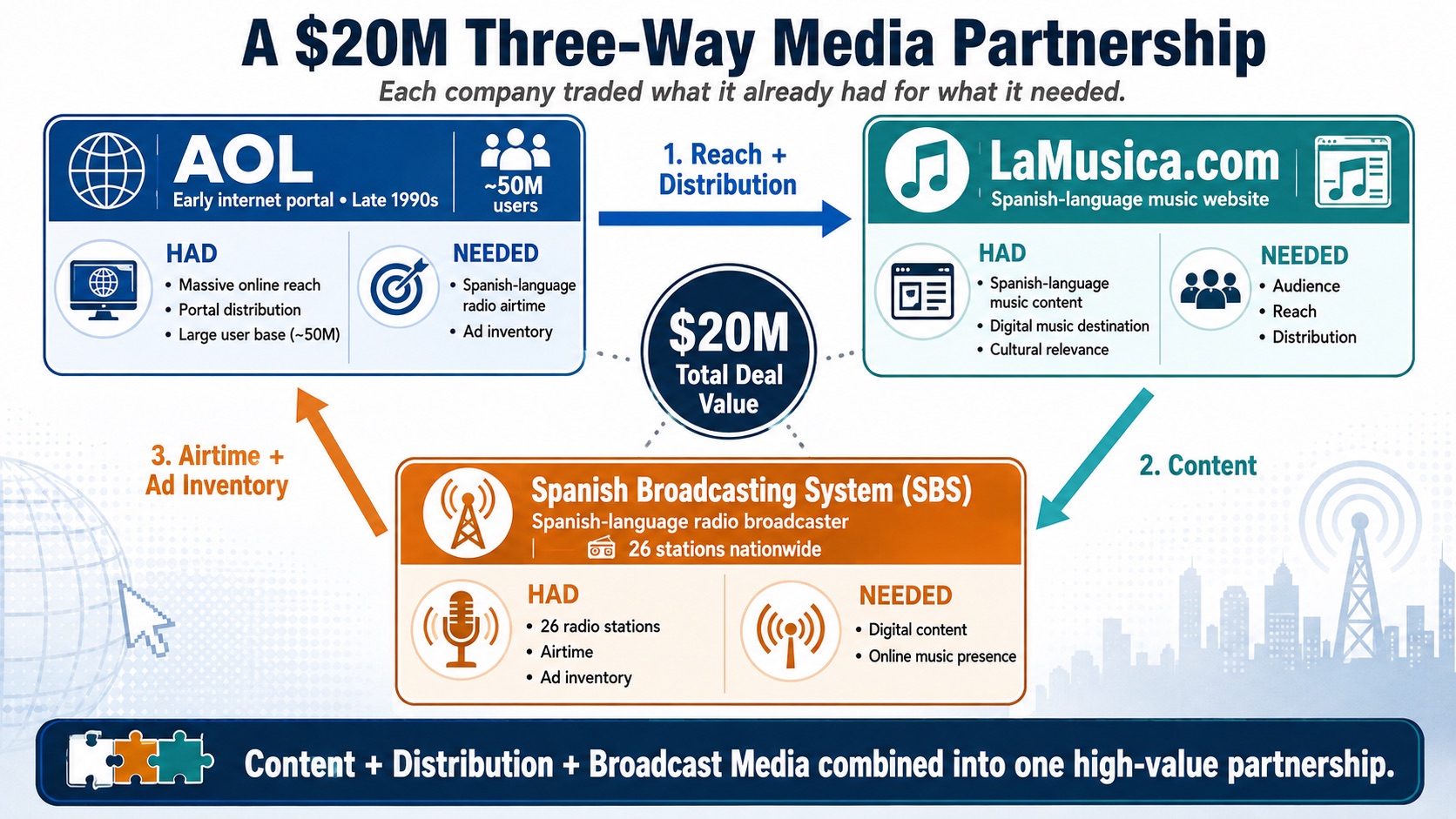
LaMusica.com had content but no reach. America Online had roughly 50 million monthly users but charged anchor-tenancy fees a startup webzine couldn't afford. Spanish Broadcasting System owned 26 radio stations nationwide and wanted into digital, but had no content engine of its own. All three had something the others needed — the deal just wasn't pricing itself that way.
Nobody was asking what each side actually owned instead of what each side could pay. It was a pricing-model problem, not a demand problem.
Structured a three-way value swap: LaMusica's content syndicated onto the radio stations' own websites; SBS radio spots syndicated to AOL as "payment" for LaMusica's anchor-tenancy fee, at no cost against LaMusica's own ad inventory.
SBS acquired a controlling interest in the company and a two-year AOL carriage agreement followed, reaching roughly one billion impressions. The company survived the dot-com crash while most of its competitors — including well-funded ones — didn't.
Operational Turnaround — Shendell Realty / SRG Contracting: 6x Revenue in 12 Months
Shendell Realty was launching a repairs division, SRG Contracting, but ten in-house repairmen were generating pilferage and unnecessary billable work — a management nightmare that ate revenue as fast as it came in the door.
The org chart itself was the constraint. There was no way to trace a repair back to who ordered it, who did it, or why — so the waste had nowhere to be caught.
Replaced the ten staff repairmen with third-party independent contractors, and built a job-ticket system on software the company already owned (BJ Murray) to track every repair, contractor, and invoice back to its source.
Revenue went from $150K to $900K in twelve months — 6x — on the same book of business, once the leak was closed.
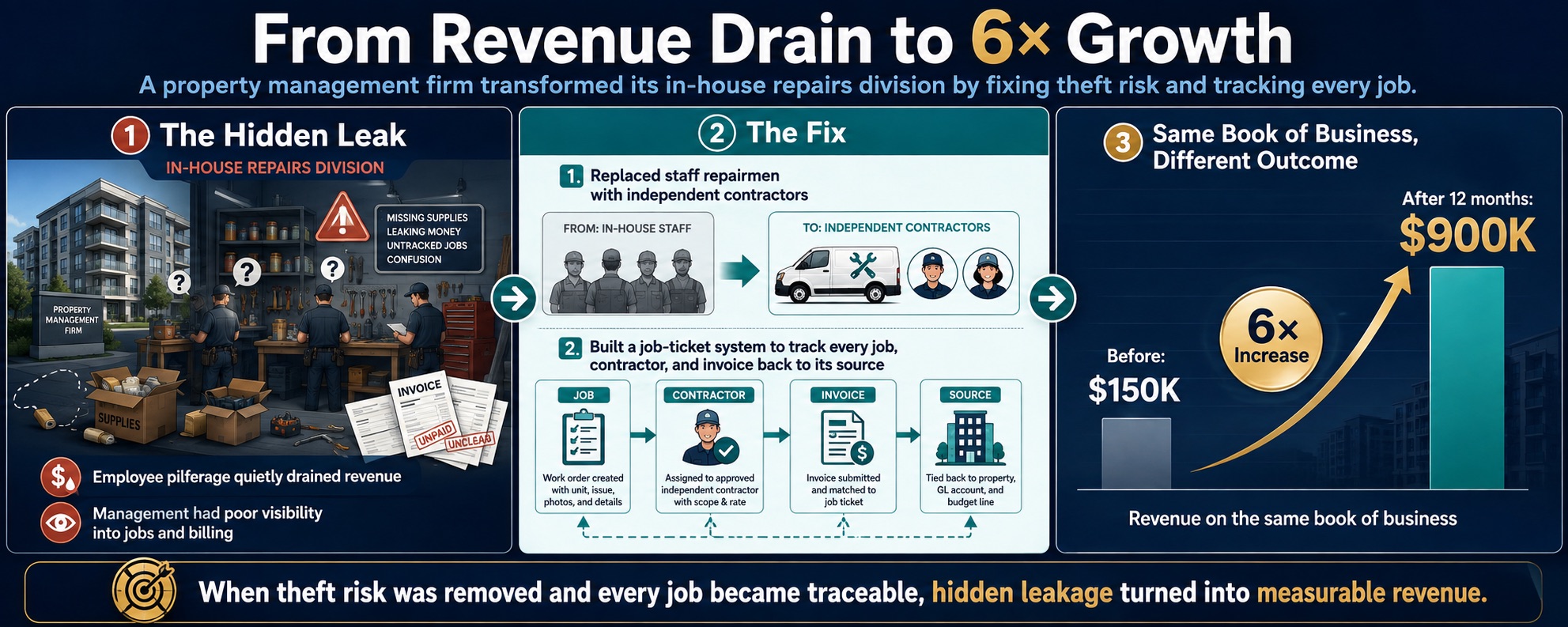
- Tenant repair call
- Open job ticket
- Assign to contractor
- Completed, signed ticket
- Submit to accounting
- Bill property, pay vendor
The Credit-Terminal Idea — Langsam Property Services & the Sheridan Manor Joint Venture
Every rental applicant's credit check ran through a third-party bureau. During my job interview with Langsam's president, Mark Engel, in 1988, I pitched him on installing an in-house terminal and cutting the middleman out entirely. He said no on the spot: "We're not a credit repair company." He hired me anyway, as a property manager for the firm.
Once I was already working for Mark, Langsam entered a joint venture with Sparrow Construction on Sheridan Manor — one of the largest lease-ups the firm had taken on, 450 units, run as a city-monitored rental lottery tied to government funding, with over 7,000 applicants expected. Mark hand-picked me for the assignment.
Two problems at once: a manual credit-check process that couldn't move at lottery volume, and margin economics nobody had rethought. For years, Langsam had simply resold the third-party bureau's reports — paying about $25 and charging applicants $30, a $5 spread. Sheridan Manor's own program rules allowed a $50 charge per report, while the real terminal cost was still about $2.
Built the in-house credit terminal at Langsam's own office — the right place for it, since Langsam was the management company actually running the credit checks — capturing roughly $48 in margin per report instead of a few dollars. On-site at Sheridan Manor itself, converted two ground-floor apartments into an intake office where applicants started the application and could view model units in person; a consultant built custom data-collection software so the paperwork from that intake fed straight into the system, handling all 7,000 applicants. Sheridan Manor was the proving ground — the volume that tested whether the whole idea actually worked at scale.
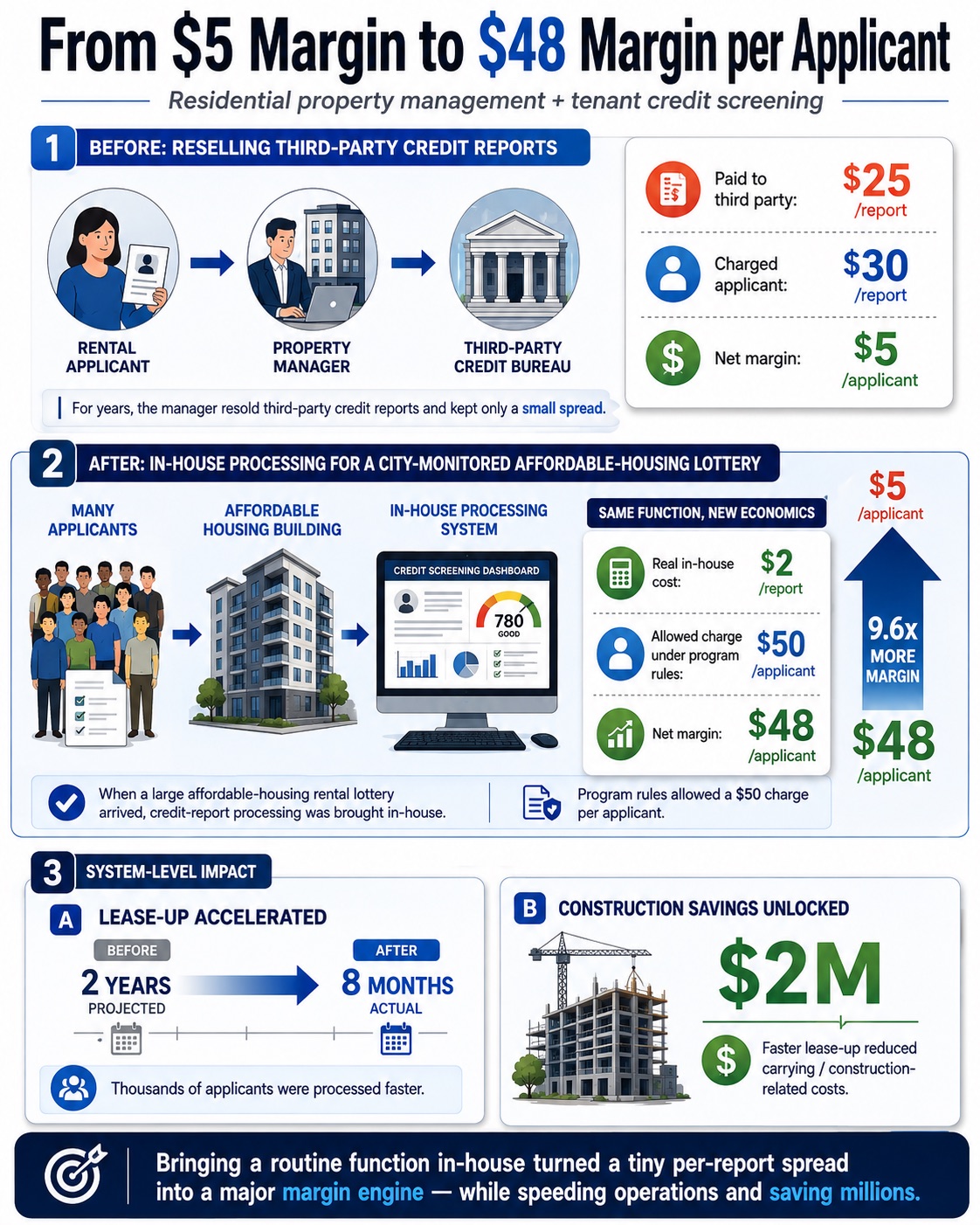
$5,000 in credit-report margin in the first week alone — a wildly successful test. The same intake system compressed the developer's projected two-year lease-up to eight months, unlocking roughly $2 million in construction savings through a shorter interest-carry period.
"Mr. Rodriguez demonstrated strong skills and abilities in all aspects of his position as a managing agent. From working closely with property owners in meeting their objectives to training and directing support and maintenance staff, Mr. Rodriguez proved he was able to set and accomplish all of this firm's goals successfully."
— Mark Engel, President, Ralph Langsam Associates, Inc., April 9, 1992. Written to Juan Rodriguez — the name on my employment and filings before my later legal name change to Guardiola. Same person.
Acquisition Discipline — A Seven-Property Real Estate Portfolio
Most flippers lose margin two ways: they overpay for a property, or they misjudge the true cost of the repairs. The "edge" most of them are actually relying on is market timing, not skill.
The constraint wasn't capital or market conditions. It was buying right in the first place — accurately, before the offer goes in, not after.
Applied a pattern-recognition approach to specific neighborhoods, built a network of contractors who returned accurate repair estimates, and priced every purchase to the true all-in cost rather than the sticker price.
Consistent 30–40% margins across the following seven properties, purchased, renovated, and sold on my own account.
| Property | Purchased | Repairs | Sold |
|---|---|---|---|
| 5516 Sardinia Ave, South Florida | $365K | $13K | $525K |
| 8162 SW 62nd Ave, South Florida | $410K | $0 | $625K |
| 425 NW 125th St, South Florida | $85K | $9K | $145K |
| 404 E 66th St, Unit 1M (Condo), New York | $137K | $16K | $425K |
| 304 E 41st St, Unit 6E (Coop), New York | $117K | $3K | $171K |
| 4000 Collins Ave, Unit 204 (Condo), Miami Beach | $29K | $5K | $135K |
| 4000 Collins Ave, Unit 409 (Condo), Miami Beach | $30K | $3K | $85K |
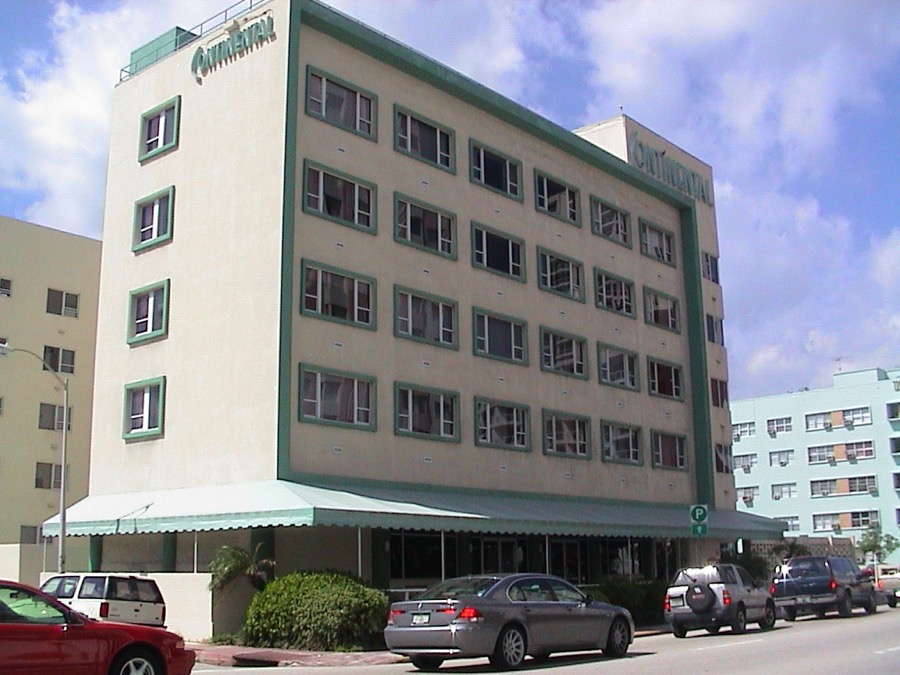






A sample of the before-and-after work behind these numbers — exteriors and interiors from across the portfolio, from the original 2010 presentation.
Pricing & Delivery Model — 6x Hourly Rate for a Licensed Aesthetician Client
The first four cases run from a $20M media deal down to a 450-unit joint venture. This one is a single person, not a company at all — deliberately placed last to make the point: the method doesn't care about the size of the client. A bottleneck is a bottleneck whether it's costing a corporation millions or costing one working person half their hourly rate.
A licensed aesthetician client was working 12-hour days teaching at an institute, earning $25/hour gross — closer to $13/hour net once space, supplies, and other costs were counted. She had deep, real expertise. The problem was never her skill; it was how she was selling it.
An hourly service model caps income at physical exhaustion, no matter how good the practitioner is.
Repackaged her expertise into a one-day, nine-hour licensure-renewal intensive, and ran a direct-marketing push — her existing email list, Facebook, meetup.com — to fill it, inside a 25-day window.
Ten students at $100 each. Net revenue of $700 for nine hours of work — $77.77/hour, a 6x increase on the same expertise, using a format she could repeat every renewal cycle.

What this adds up to
Four of these five fixes were structural — a pricing model, a workflow, a piece of already-owned software used differently. The one time I did replace staff, it wasn't a strategy, it was a response: a demonstrated pattern of pilferage had already told me who the problem was.
My mission has always been to connect with people and make the businesses around them run better — not to make the people optional. The fix is almost always the system. Every once in a while, it's the person. Knowing which one you're looking at is the actual skill.
The five questions I ask
- Where does the logic narrow? What's the one thing that, if removed, would unlock the most growth — not the biggest problem, the bottleneck.
- What's being avoided? What change would be obvious if someone actually looked — the pricing, the staffing, the distribution model — but nobody's looking?
- What's the current constraint on growth: capital, market demand, or operations? If it's operations, that bottleneck is yours to remove.
- What value is leaking invisibly? A middleman siphoning margin, a process eating time, a model capping income — find the leak.
- What would a real multiplier look like if this one thing were gone? It's usually not capital-intensive. Removing a bottleneck is a model change, not a spend.